
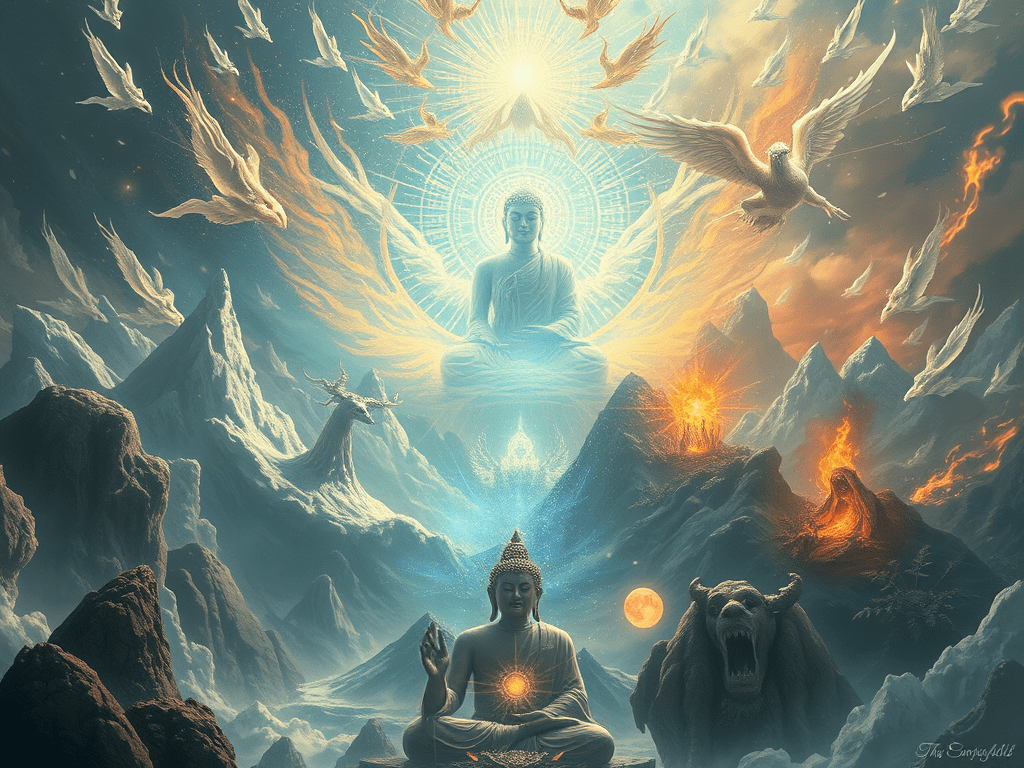
Answer: The realms of existence are divided in several ways:
When categorized by composition, the Human Realm and the Animal Realm are considered realms of visible matter, while the realms of Heaven, Demi-God, Hungry Ghosts, and Hell are realms of invisible spirits.
If divided by merit, the Animal, Hungry Ghost and Hell realms are characterized by low merit and high sin, where beings experience significant suffering. The Human realm is a mixed realm, where beings have both sin and merit, experiencing both happiness and suffering, while the realms of Heavens and Demi-Gods are realms of high merit, where beings enjoy great happiness and blessings.
If divided by psychophysiological characteristics, the Desire Realm includes six heavenly realms (The Heaven of Delight in Creation (Nirmāṇarati), the Heaven of Joyous Emanations (Parinirmita-vasavartin), the Heaven of Contentment (Tuṣita), the Yama Heaven (Yāma), the Heaven of the Thirty-Three (Trāyastriṃśa), the Heaven of the Four Great Kings (Cāturmahārājika). It also includes the Human realm, the Animal realm, the realm of hungry ghosts, and the hell realm. A defining characteristic of beings in the Desire Realm is that they still possess sensual desires.
Above the Desire Realm are the realms of the Form Realm. Here, the Celestial Beings possess very large forms but no longer have sensual desires. The Form Realm consists of 18 levels, which are actually divided into four stages of meditative concentration, from the First Jhana to the Fourth Jhana. Those who achieve the First Jhana or higher in their practice will be reborn in the Form Realm after leaving the Human realm.
Higher than the Form Realm is the Formless Realm, which comprises four levels. In this realm, deities have transcended both sensual desires and physical form, existing as pure, intangible consciousness.
The Buddhist cosmology is vast and thorough, offering a comprehensive understanding of the universe that surpasses any other religious or philosophical perspective.





Leave a comment