
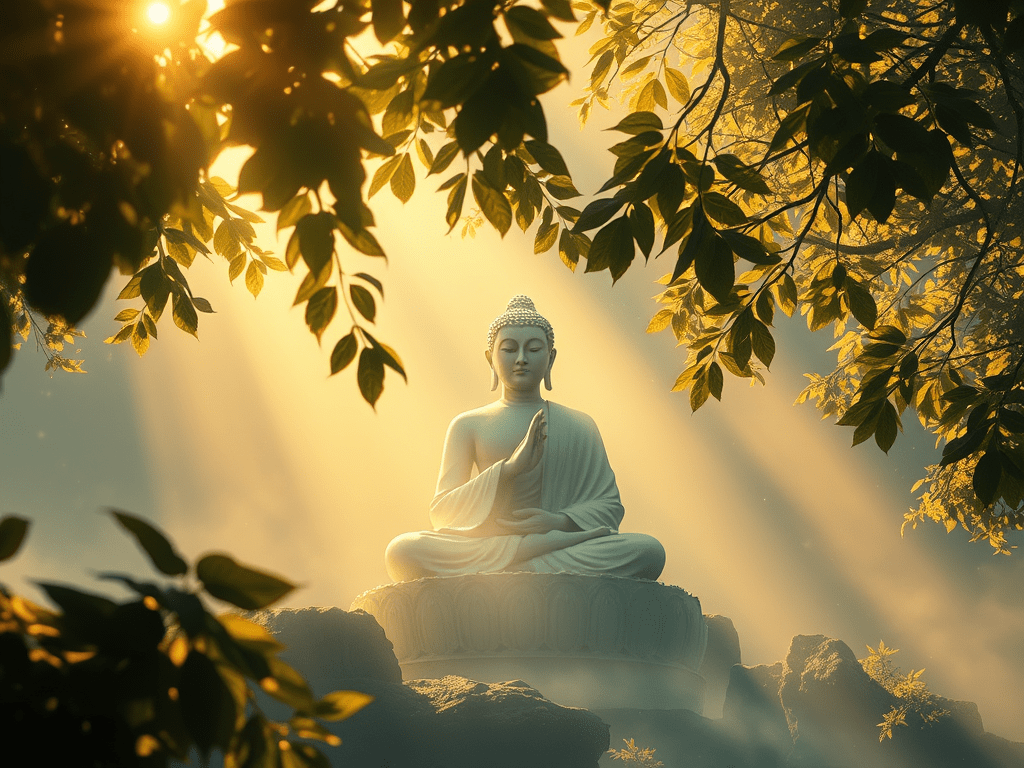
Answer: The Truth of the Cessation of Suffering (Nirodha) refers to the state of being free from suffering, known as enlightenment and liberation, achieved through successful spiritual practice in line with the Buddha’s teachings.
While many religions see reaching heaven after death as the ultimate goal for a faithful follower, Buddhism defines true spiritual success as achieving extraordinary inner enlightenment. After attaining enlightenment, one can freely choose where to be or choose not to exist in any place at all. There are four stages of enlightenment:
- Arahant (Arhat): The fourth and highest stage of enlightenment. An Arahant possesses the Threefold Knowledge and Six Supernormal Powers, achieving complete liberation from the universe, with boundless wisdom and enlightenment.
- Anāgāmi (Non-returner): The third stage of enlightenment. An Anāgāmi is no lon mới ger reborn into the human realm unless they choose to be. They possess great spiritual powers and wisdom, and often reside in the highest heaven of the Form Realm (Suddhāvāsa), continuing their practice until they attain Arahantship and enter Nirvana.
- Sakadāgāmi (Once-returner): The second stage of enlightenment. A Sakadāgāmi may be reborn in the human realm once more to complete their virtues and aspirations. They possess a very pure mind and some basic supernormal powers. After death, they are often reborn in the Tusita Heaven to learn from Maitreya Buddha, the future Buddha of Earth in the next hundreds of thousands of years.
- Sotāpanna (Stream-enterer): The first stage of enlightenment. A Sotāpanna may be reborn multiple times into the human realm to fulfil their virtuous aspirations for themselves and other beings. They have an unwavering commitment to morality and absolute reverence for the Buddha. However, they do not yet have enough supernatural wisdom to discern reality from illusion, so they still make mistakes and have karma to resolve. A Sotāpanna may be reborn in the Heavens of Desire Realm or multiple times in the human realm. They often engage in good deeds, resulting in good connections with beings and easily earning blessings.
The Threefold Knowledge of an Arahant includes:
- Knowledge of Past Lives (Pubbenivāsānussati-ñāṇa): The ability to see one’s countless past lives in great detail and understand one’s connections with innumerable other beings.
- Knowledge of the Death and Rebirth of Beings (Dibbacakkhu): The ability to see the rebirth of beings across countless lifetimes, observing their karmic actions and consequences according to the Law of Karma with clarity and detail.
- Knowledge of the End of Mental Defilements (Āsavakkhaya-ñāṇa): The ability to see the ultimate truth of the universe, understanding the Four Noble Truths and the workings of everything and every realm, with the capacity to know anything they wish to know, yet primarily grasping the profound wisdom of the Dharma.
The Six Supernormal Powers of an Arahant consists of the Threefold Knowledge and add the following:
- Supernatural Power (Iddhi-vidhā): The ability to perform supernatural feats, such as flying, creating multiple bodies, manipulating the elements, and transforming environments.
- Telepathy (Cetopariya-ñāṇa): The ability to know the thoughts of other beings, even from a great distance.
- Clairaudience (Dibbasota): The ability to hear sounds of beings from all realms.
The realms of Heavens can also be considered as part of the Cessation of Suffering because they alleviate many sufferings experienced in the human and animal realms. However, true Cessation of Suffering in Buddhism is only achieved through attaining inner enlightenment.





Leave a reply to Collection Of 100 Buddhism Questions Answered For Beginners – BUDDHISM FOR BEGINNERS Cancel reply