
Answer: The fundamental principles of a meditation method that can be applied to all individuals include the following:
- Encouraging the accumulation of merit: To enter deep ecstasy in meditation, one must have great merit. Because achieving a tranquil mind in meditation is akin to reaching the state of the heavenly realm, which requires substantial merit.
- Reverence for the Buddha and Arahants: This is the basic merit for meditation. According to the Law of Karma, honoring teachers allows one to become a teacher in the future; similarly, showing reverence to Enlightened Ones who have achieved the ultimate level of ecstasy in meditation enables one to attain higher meditative states.
- Regularly repentance for past sins: Practitioners should regularly pay homage to the Buddha to repent for past sins in daily life.
- Cultivation of inner morality: Practitioners must be thorough and determined in perfecting inner morality, identifying and correcting every fault, as a tranquil mind follows a virtuous heart.
- Maintaining good health: Meditation practice requires good health. Practitioners need to engage in physical exercises like Qigong, follow a balanced diet, work and rest appropriately, and get enough sleep.
When practicing meditation, the following basic methods should be observed:
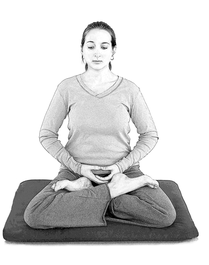
- Proper sitting posture: Sit in the full lotus position in a quiet, cool, secluded place. Keep the body relaxed and still. Position the arms with elbows slightly away from the sides rather than pressed against the body. Keep the back straight but not tense. Initially, keep the eyes open, looking down at a spot in front of us with the head slightly bowed; once the mind is more mindful, it is ok to close the eyes. Keep the mouth gently closed, with the tongue touching the upper gums.
- Cultivation of fundamental morality: Develop intentions to revere the Buddha absolutely, love all beings boundlessly, and maintain utmost humility.
- Praying for guidance: Pray for the Buddha’s guidance to achieve a deep meditative state towards ultimate selflessness.
- Contemplating the body and mind: Reflect that this body and mind are the result of deep-seated past sins.
- Acknowledging distraction: Begin to recognize when the mind is led by wandering thoughts. Do not try to forcefully eliminate these thoughts or concern ourselves with their content; simply be aware of their presence. When we realize that the mind is distracted, we have achieved an initial stage of mindfulness.
- Maintaining mindfulness: Focus our sensations on the chest and abdomen, as these areas help sustain mindfulness and prevent strong wandering thoughts from leading the mind astray. This is the second stage of mindfulness.
- Contemplating impermanence: Reflect on the body’s impermanence – it will age, fall ill, and eventually die. This is the third step of awareness.
- Regulating breathing: Keep the breath slow, little, and gentle. With mindfulness, the breath becomes clear, but inner impulses may cause it to be rapid, deep and strong. So, carefully maintain slow, shallow, and gentle breathing to prevent these impulses from taking over. This is the fourth stage of mindfulness.
- Mindfulness of the entire body: Be mindful of the whole body, sensing down to the bottom of the abdomen, including the Dan Tian and Hui Yin acupoints. Awareness of the bottom of the abdomen can help heal some latent brain injuries and make the mind more tranquil. This is the fifth stage of mindfulness.
- Recognizing deep-seated ignorance: As mindfulness becomes sustained and the mind is less frequently led astray by wandering thoughts, constantly remind ourselves that ignorance and sins still reside deep within the mind. This is the sixth step of awareness.
Practitioners should repeat these six mindfulness stages to maintain awareness and prevent the mind from being led astray by wandering thoughts.
Additionally, contemplating the body and mind as an accumulation of karmic wrongdoings from countless past lives also helps maintain awareness, because it means that we are recognizing our state, acknowledging our karma, and understanding our nature, which aids in repentance and lightens our karmic burden.
As mindfulness strengthens, many more states of awareness will emerge, which we will discuss later.





Leave a reply to Collection Of 100 Buddhism Questions Answered For Beginners – BUDDHISM FOR BEGINNERS Cancel reply